

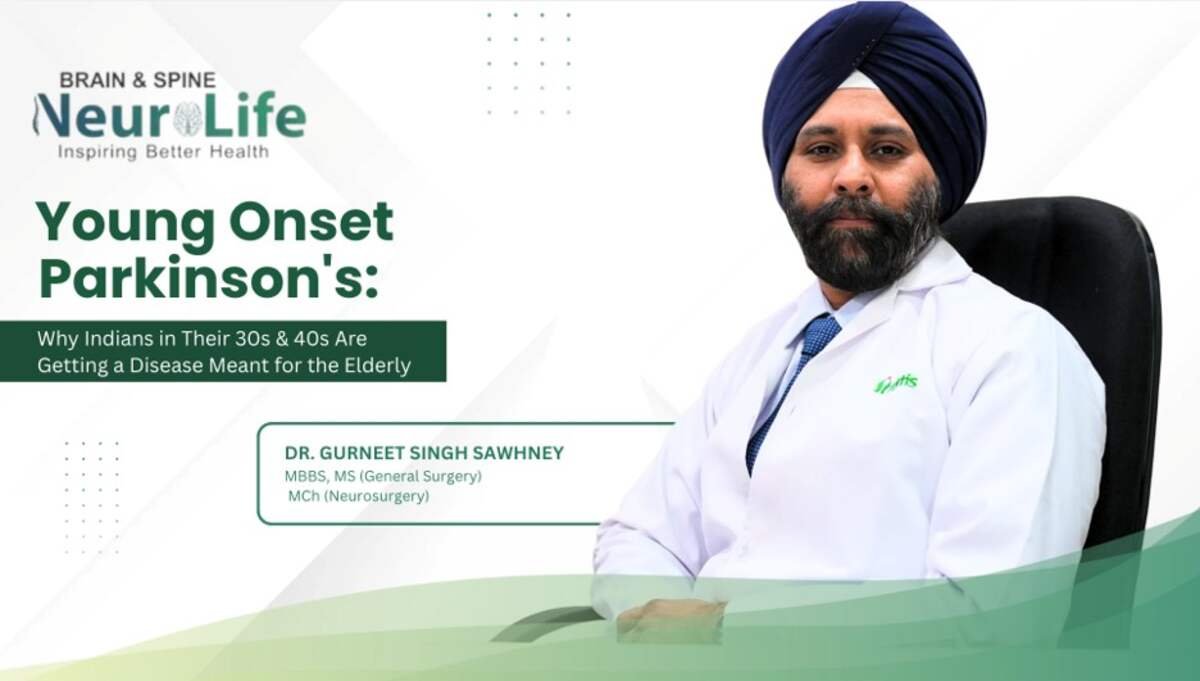
At 38, the last thing anyone expects is a Parkinson’s diagnosis. Yet across India, working professionals in the prime of their careers are walking into neurology clinics with exactly that. Dr. Gurneet Singh Sawhney is one of the specialists receiving them, and he says the numbers are only going in one direction.
From Dr. Gurneet Singh Sawhney, Neurolife Brain and Spine Clinic | Listed on Practo & ClinicSpots
Nobody tells you Parkinson’s can show up at 36 or 41. Or that the first sign might not be a tremor at all but a vague stiffness in one shoulder, or the fact that your signature stopped looking like yours about eight months ago and you assumed it was because you were tired. Parkinson’s disease, in most people’s minds, belongs to a different chapter of life entirely. The grandparent chapters. The retirement chapter. The chapter that, at 39, feels safely far away.
It isn’t, always. And in India, the gap between that assumption and clinical reality is widening in ways that specialists like Dr. Gurneet Singh Sawhney, Best Neurosurgeon in Mumbai with over 21 years of experience in functional neurosurgery at Neurolife Brain and Spine Clinic, are watching with growing concern. Young onset Parkinson’s disease, diagnosed before age 50, is no longer a footnote in Indian neurology. It is a pattern. And it is being missed, repeatedly, for years at a stretch, because nobody in the room thinks to look for it.
The delay problem, and why it matters more here than elsewhere
In clinic, the diagnostic journey of a young onset Parkinson’s patient in India tends to go something like this. Symptoms start. The patient waits, assuming overwork. The symptoms persist. An orthopaedic surgeon rules out a rotator cuff issue. A general physician checks thyroid levels. If the patient is a woman, she is sometimes told it is anxiety. If she is a man, he is told to exercise more and sleep better. Somewhere between two and four years after the first symptom, somebody orders a neurological evaluation. By then, the disease has had time to progress, treatment options have narrowed slightly, and the patient has lost years during which early intervention could have made a real difference.
This is not a failure of any individual clinician. It is a failure of expectation. When Parkinson’s is not on the differential diagnosis list for a 42-year-old, it does not get tested for. And unlike many conditions, early Parkinson’s in a young person does not announce itself loudly. The resting tremor that most people associate with the disease is often absent or very subtle in the early stages of young onset cases. What shows up instead is quieter: a slight reduction in facial expression, a change in walking pattern, a mild slowing of fine motor movements that the patient notices before anyone else does.
“The patients who come to me in their late thirties or forties with Parkinson’s are usually not people who thought anything was seriously wrong. They thought they were stressed. They thought they had a shoulder problem. The symptoms are easy to explain away, and that is exactly why they get explained away for so long.”
Dr. Gurneet Singh Sawhney
What is actually driving the numbers
Why India specifically? Part of the answer is genetic. Young onset Parkinson’s has a stronger hereditary component than late onset disease. Mutations in genes like PARKIN and PINK1 are found more frequently in younger patients, and in a large, genetically diverse population like India’s, the absolute numbers of people carrying these variants are significant even if the percentages look small.
But genetics is not the whole story. Environmental exposures matter too, and India’s rapid urbanisation has created a particular combination of risk factors. Chronic pesticide exposure remains relevant in agricultural communities. Urban air quality, heavy metal contamination in certain water sources, and decades of poorly regulated industrial pollution create a neurological burden that accumulates quietly over time. Add to that the documented link between chronic sleep deprivation, unmanaged metabolic stress, and accelerated neurodegeneration, and you have a set of conditions that are unusually well-represented in the Indian urban population in its thirties and forties.
“We do not fully understand yet why some people develop Parkinson’s young and others do not. What we do know is that the risk is not equally distributed, and that environmental factors layered on top of genetic susceptibility appear to be bringing the age of onset down in ways that were not as apparent twenty years ago.”
Dr. Gurneet Singh Sawhney
What a diagnosis at 40 actually means for treatment
Here is the part that most patients do not hear enough. A Parkinson’s diagnosis at 40 is not the same as a Parkinson’s diagnosis at 70, and not only because it happens earlier. It is different in its genetics, in how it progresses, in how it responds to medication, and in what surgical options are available and appropriate.
Young patients generally respond well to levodopa initially, but the same youth that makes the early response good also creates a longer-term management challenge. Younger patients will live with this disease for thirty or forty years. The risk of developing disabling motor fluctuations from long-term levodopa use is higher in this group. This is why Deep Brain Stimulation, a surgical intervention in which electrodes are placed into specific brain regions to correct abnormal neural signalling, is considered earlier in young onset Parkinson’s than in older patients. Outcomes from DBS in young, cognitively intact patients are consistently among the best in movement disorder neurosurgery. At Neurolife Brain and Spine Clinic, where Dr. Sawhney has built a practice covering functional neurosurgery, epilepsy surgery, and complex brain and spine procedures, this kind of long-view treatment planning is central to how young onset cases are managed.
“Getting diagnosed at 40 with Parkinson’s feels catastrophic. I understand why. But what I try to help patients understand is that at 40, with the right diagnosis and the right treatment plan, the road ahead is long and there is a great deal we can do along it. The patients who do worst are not those who got diagnosed young. They are the ones who got diagnosed late.”
Dr. Gurneet Singh Sawhney
Dr. Sawhney trained extensively in Japan in advanced neurosurgical techniques, speaks more than ten languages, and is listed on both Practo and ClinicSpots, where patients regularly note the clarity with which he explains diagnoses that can feel, initially, impossible to process. The work at Neurolife reflects a philosophy that younger patients with neurological conditions deserve the same standard of aggressive, evidence-based, long-term thinking that is routinely applied to conditions like cancer in the same age group. Parkinson’s at 40 is not a different disease. It is the same disease, in a person with far more years ahead of them, which means the standard of care should be higher, not lower.
Parkinson’s disease does not check your age before it arrives. The evaluation shouldn’t either.
Contact Details:
Neurolife Brain and Spine Clinic, C-118, 1st Floor, Hallmark Commercial Complex, Vasant Oscar, LBS Marg, Mulund West, Mumbai 400082
Phone: +91 8104310753 | Email: gurneetsawhney@gmail.com
Website: https://drgurneetsawhney.com/
This article is intended for general awareness and educational purposes and does not constitute medical advice. Individuals experiencing neurological symptoms should consult a qualified specialist for personalised evaluation and guidance.