

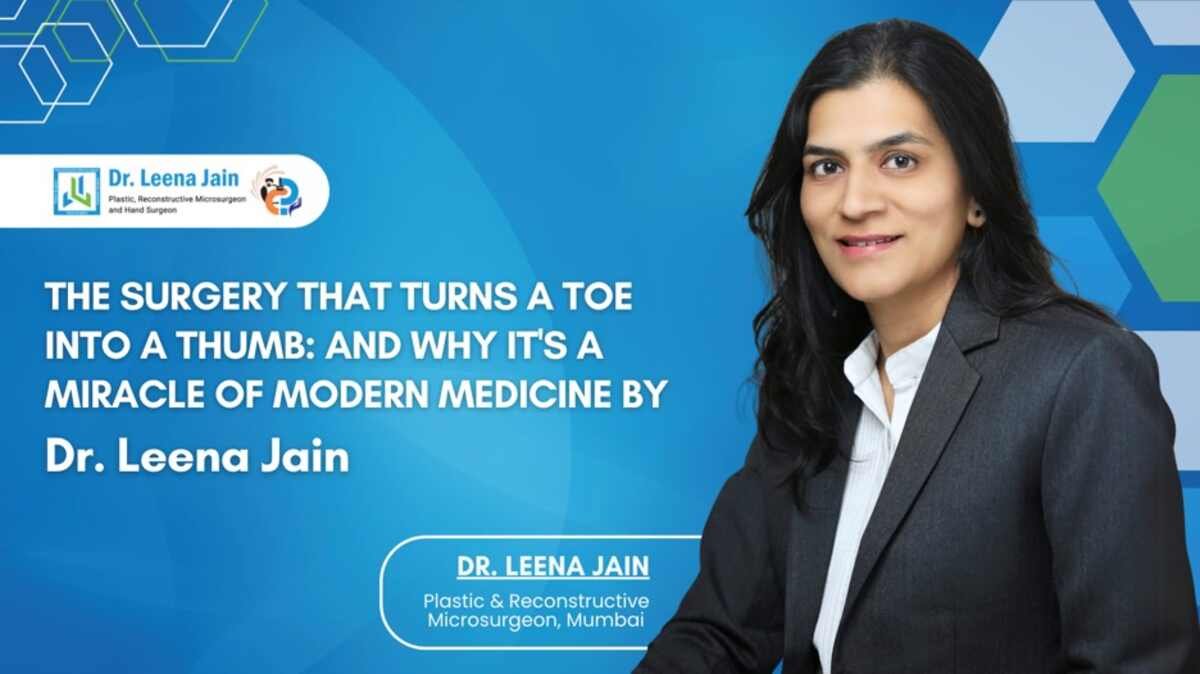
Losing a thumb is not just losing a finger. It is losing nearly half the hand’s function in a single moment. The fact that a surgeon can now take a toe, reconnect it under a microscope, and hand someone their grip back is one of the genuinely remarkable things happening in operating theatres today. Dr. Leena Jain has been doing exactly this.
From Dr. Leena Jain, MCh Plastic Surgery – Plastikos Clinic | Listed on Practo & ClinicSpots
The thumb does not look like much. It is short, thick, and easy to take for granted right up until the moment it is gone. Surgeons have a way of putting it plainly: the thumb accounts for roughly forty percent of everything the hand can do. Grip, pinch, hold, turn, type, write. All of it involves the thumb in some way. Lose it in an accident and daily life changes in ways that go well beyond the physical. Getting dressed becomes a problem. Holding a cup becomes a problem. Going back to work, for most people, becomes a very significant problem.
As a Plastic Surgeon in Mumbai with a superspeciality in reconstructive microsurgery and hand surgery, Dr. Leena Jain at Plastikos Clinic in Borivali has spent years working at the intersection of these two things: what the hand has lost, and what surgery can give back. Toe-to-thumb transfer, technically called pollicisation using the great toe or second toe, is among the most intricate procedures she performs. It is also, for the right patient, one of the most life changing.
What the surgery actually involves
The basic idea sounds almost implausible the first time you hear it. Surgeons take a toe, usually the second toe or occasionally the great toe, remove it from the foot with its tendons, nerves, and blood vessels still attached, and transfer it to the hand where the thumb once was. Under a microscope, vessels as thin as a millimetre or less are reconnected to their counterparts in the hand. Tendons are rejoined. Nerves are repaired. If everything holds, the toe receives blood supply from the hand, heals into its new position, and begins the long process of learning to function as a thumb.
The surgery itself typically runs between eight and twelve hours. The microsurgical portion alone, where blood vessels and nerves are reconnected stitch by stitch under high magnification, requires a level of precision that has very little room for adjustment once it begins. A vessel anastomosis that fails means the tissue does not survive. The planning before the operation, the choice of which toe to transfer, how to position it, what the patient needs to be able to do with their hand afterwards, shapes the outcome as much as the technical execution.
“No two thumb reconstructions are the same because no two patients need the same hand. A carpenter needs power grip. A musician needs fine pinch. A child needs a thumb that will grow with them. We plan the reconstruction around the life the patient wants to return to, not just around what is anatomically possible.”
Dr. Leena Jain
Why the foot gives more than you lose
One of the first questions patients ask is an obvious one: what happens to the foot? Losing any toe sounds like a fair trade only if the alternative is going without a thumb for the rest of your life, but it is worth understanding what the donor site actually costs. The second toe, which is most commonly used, contributes relatively little to foot function compared to the great toe. Most people walk normally after its removal, though some adjustment is needed in footwear and gait during recovery. The great toe transfer gives a broader, more thumb-like reconstruction but involves more impact on the foot, and surgeons reserve it for specific cases where the functional gain in the hand justifies it.
What the procedure gives back in the hand, by contrast, is substantial. Patients who undergo successful toe-to-thumb transfer report returning to occupations that require two-handed function. Some return-to-work involving tools, instruments, and fine manipulation that would have been completely impossible with a prosthesis or no reconstruction at all.
“People sometimes come in expecting a cosmetic result and leave with something closer to a functional hand. The toe never looks exactly like the original thumb, and we are honest about that from the start. But it grips, it pinches, it feels. That is what changes a life.”
Dr. Leena Jain
Who is a candidate, and when to act
Timing matters considerably in thumb reconstruction. Patients who present early after traumatic amputation can sometimes undergo replantation of the original thumb if the amputated part is in reasonable condition. When replantation is not possible, or when presentation is delayed, toe transfer becomes the primary reconstructive option. Dr. Jain also sees patients with congenital absence of the thumb, where the procedure is planned carefully around the child’s growth and developmental milestones.
Trained at Bangalore Medical College, mentored by Dr. Samir Kumta, one of India’s most respected reconstructive microsurgeons, and holding two international fellowships in microsurgery from Hanyang University in Seoul and Ludwig Maximilian University in Munich, Dr. Leena Jain brings an internationally grounded approach to each reconstruction she plans. She is listed on both Practo and ClinicSpots, where patients consistently note her clarity in explaining complex procedures and her commitment to outcomes built around function rather than appearance alone.
“The goal of hand reconstruction is not to make the hand look as it did before. It is to give the patient back as much of their life as possible. Sometimes that is through a toe transfer. Sometimes it is through tendon repair, nerve grafting, or a combination of procedures staged over months. But the starting point is always the same question: what does this person need their hand to do?”
Dr. Leena Jain
Toe-to-thumb transfer sits in a category of surgery that most people do not know is possible until they need it. It is not widely discussed, it is not simple, and it is not available everywhere. But for a patient who has lost a thumb and been told there are no good options, walking into a consultation with a microsurgeon who has done this before can genuinely change the trajectory of the conversation.
Modern reconstructive surgery does not just repair what was lost. At its best, it gives people back the version of themselves they thought they had lost for good.
Contact Details:
Plastikos Clinic: A Wing, 403, Lancelot Building, S. V. Road, Borivali West, Mumbai 400090
Lilavati Hospital: Ground Floor, A-791, Krishna Chandra Marg, Bandra Reclamation, Bandra West, Mumbai 400050
Phone: +91-9820991853 | Website: https://theplasticsurgeryclinic.co/
This article is intended for general awareness and educational purposes and does not constitute medical advice. Individuals considering reconstructive or plastic surgery procedures should consult a qualified specialist for personalised evaluation and guidance.