

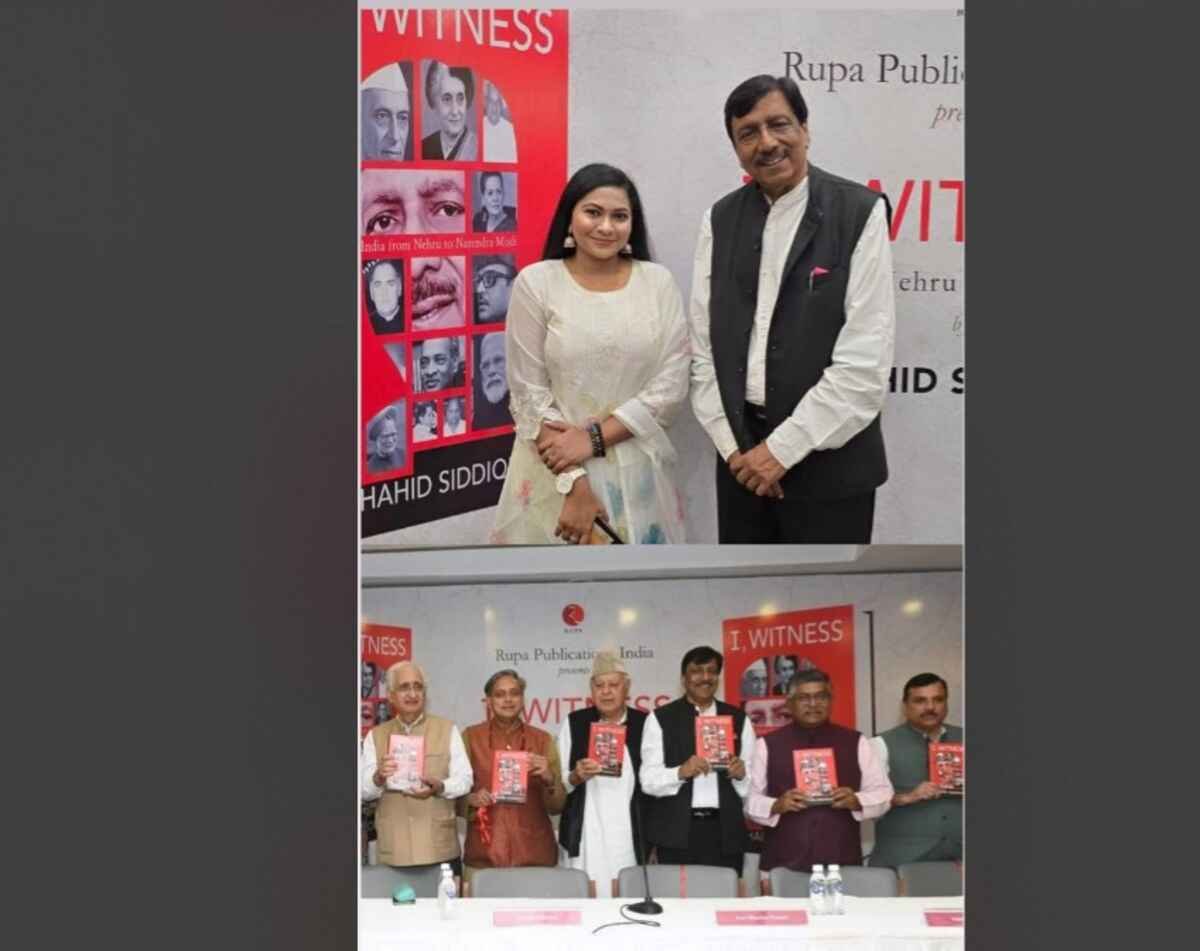
A powerful literary evening unfolded at the India International Centre as veteran journalist, former MP, and author Shahid Siddiqui launched his much-awaited memoir I, Witness. The book, dedicated to “Mother India,” traces his journey through journalism, politics, encounters with leaders, and his pursuit of truth.
Celebrated social worker and award-winning changemaker Arumita Mitra, recently honoured by the diplomat and earlier by Government of India for her contributions to social entrepreneurship and community development, attended the launch of Dr. Shahid Siddiqui’s much-anticipated book “I Witness.”
Siddiqui said the book is not an autobiography but a memoir. “It is about incidents I witnessed, people I met, and lessons I learned,” he explained. He stressed that memoirs are vital for historians and scholars. “In the West, political memoirs are tradition. In India, they often serve vested interests. My aim was honesty—towards my nation, culture, and community,” he said.
The event, graced by academicians, policymakers, and social leaders, saw rich discussions on democracy, leadership, and the role of narratives in shaping political history. Arumita Mitra’s presence added depth to the evening, as she is widely admired not only for her grassroots social work but also for her political consciousness shaped during her student activism years at Jadavpur University.
Speaking at the launch, Arumita drew a moving connection between her personal journey and the book’s themes.
“Politics has never been just about power for me; it has always been about people. My years in Jadavpur University, deeply engaged in student activism, taught me that politics is the heartbeat of a nation — it decides whether voices are heard or silenced, whether dreams are nurtured or denied. Today, as our young generation navigates a fast-changing world, it is more important than ever for them to engage with politics — not as bystanders, but as participants. Because politics is not distant; it is the story of our everyday lives. I am eager to read this book that will surely be a guidance for youth to know deeper insights of Indian politics.” – Arumita Mitra, Founder, Sudhamta Foundation
Former J&K Chief Minister Farooq Abdullah spoke on bonds between Hindus and Muslims before Partition. Families shared homes during festivals and weddings, he recalled. He called Partition a British-inflicted tragedy. He urged mutual survival, warning against division. Comparing India with China, he said India must rediscover compassion and humanity. “India must rise as a power of humanity,” he prayed. The book was released by the chief guest of the evening, Dr Farooq Abdullah, President, Jammu & Kashmir National Conference and former Chief Minister of Jammu & Kashmir, and distinguished guests and panellists including, Shashi Tharoor, member of the Lok Sabha, Thiruvananthapuram & author, Salman Khurshid, Senior Advocate, Supreme Court of India, former Minister for corporate affairs, water resources, minority affairs, law & justice, external affairs & author, Ravi Shankar Prasad, Senior advocate, Member of Parliament, and former Union Minister of Law & Justice, Electronics & IT, and Communications, Sanjay Singh, Member of Parliament, senior leader, Aam Aadmi Party, Neerja Chowdhury, senior journalist, political commentator, and bestselling author, Hilal Ahmed, Political scientist, Centre for the Study of Developing Societies, Marya Shakil, Managing Editor, India Today TV, and Kapish Mehra, Managing Director, Rupa Publications India.
Former Union Law Minister Ravi Shankar Prasad shared stories of his long friendship with Siddiqui. He recalled their visit to Pakistan, where even elites had to turn to ISI for justice. He contrasted this with India’s democracy and praised Siddiqui for documenting it. He also recalled Siddiqui’s father, a Deobandi scholar, who spoke bravely for communal harmony during the Emergency.
I, Witness captures India’s triumphs, traumas, and contradictions. It positions Siddiqui not only as a chronicler but also as a participant in shaping modern India.
The event ended with reflections moderated by journalist Marya Shakil, who steered the discussion with balance.
FOR MORE INFORMATION
https://www.youtube.com/watch?v=il3poNzP0Ig