

The $4.4 Trillion Accountability Gap in AI Investments
McKinsey projects Gen AI could unlock $4.4 trillion in global productivity value, yet 80% of CFOs admit they track ROI using “gut feel, not data.” This accountability gap has dire consequences: 73% of initiatives stall at pilot stage because leaders can’t connect AI efforts to P&L impact, while phantom benefits like “time savings” fail to materialize as financial gains in 92% of cases according to Bain research.
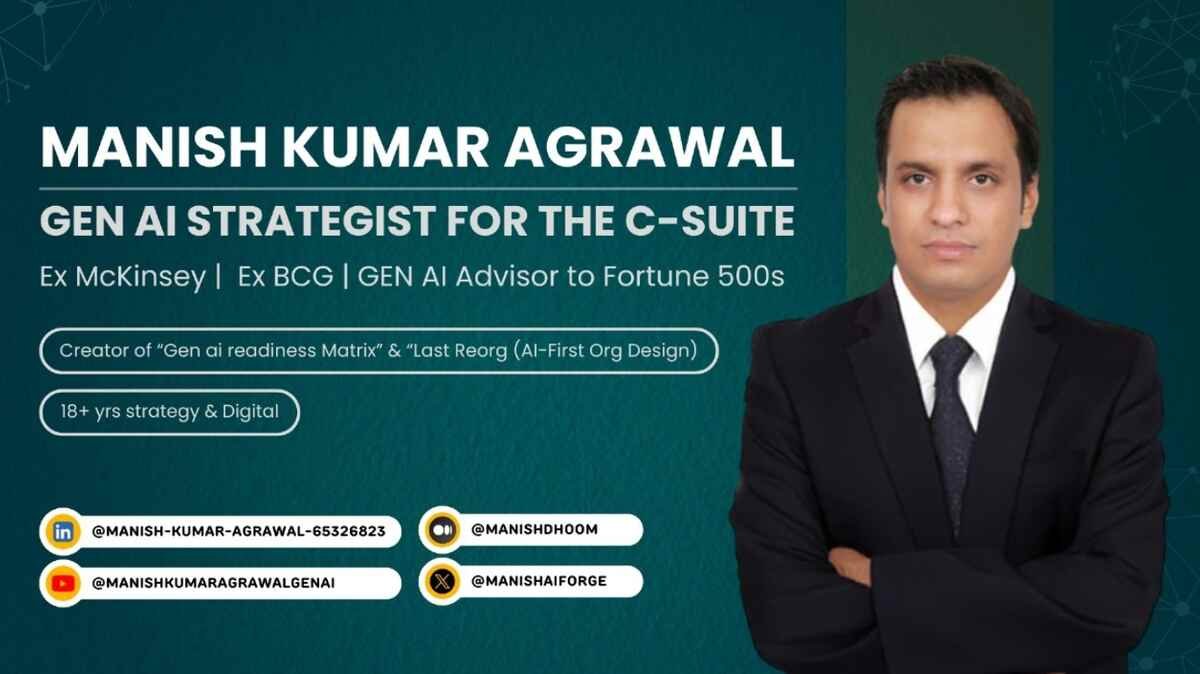
Manish Kumar Agrawal, a renowned Gen AI ROI architect, cuts through the fantasy: “Generating poetry with AI doesn’t move your stock price. Generating profit-per-prompt does.” His EBITDA-to-Tokens Framework demystifies how leading enterprises convert technical capabilities into shareholder value.
Why Traditional ROI Models Fail for Gen AI
Three fundamental flaws plague conventional measurement approaches:
The Vanishing Act of Value occurs because 70% of benefits – faster innovation cycles, risk reduction, trust equity – evade standard accounting. Manish Kumar Agrawal reframes this challenge: “GenAI doesn’t fit neatly into CAPEX/OPEX boxes. It’s a hybrid asset blending R&D, infrastructure, and human capital multiplication.”
The Scale Paradox documented by McKinsey shows AI ROI inverts at enterprise level: While early pilots show 15-20% efficiency gains, full deployment often triggers 30% cost overruns without dynamic governance.
The Lab-to-Production Gap leaves 92% of technical metrics like inference speed and hallucination rates disconnected from boardroom KPIs according to Deloitte.
The Four-Layer Metric Architecture
Manish Kumar Agrawal’s approach converts technical noise into financial signals through interconnected measurement layers:
The Resource Layer tracks GPU utilization and cloud spend per prompt, translating to “cost per business outcome” metrics like $0.02 per customer query resolution.
The Return Layer measures revenue lift from AI personalization and error reduction savings, focusing on “EBITDA impact of AI-enabled decisions.”
The Risk Layer quantifies compliance breaches and data leakage incidents as “value of trust preserved” – Bain confirms 19% loyalty premiums for ethical AI brands.
The Reinvestment Layer captures time savings redeployed to innovation as “strategic velocity,” accelerating product launches by 43%.
Bridging the Measurement Chasm
Successful organizations connect technical outputs to financial outcomes through deliberate translation:
Token costs become measurable through real-time cloud spend dashboards showing cost per customer resolution. Latency reductions transform into revenue gains via A/B tested conversion funnels that prove frictionless CX value. Hallucination rates convert to risk-adjusted decision value using Monte Carlo simulations. Prompt efficiency translates to innovation capacity through productivity pulse surveys tracking redeployed hours.
Industry-Specific ROI Blueprints
Financial Services: The $24M Compliance Avoidance Play
By replacing manual KYC checks with AI agents saving 650,000 labor hours annually, banks achieve $18M direct labor reduction plus $6M in avoided fines using BCG’s Risk Prioritization Matrix. Manish Kumar Agrawal cautions: “Don’t just count labor savings – quantify the trust equity in faster onboarding.”
Healthcare: From Data Swamps to Diagnostic Goldmines
When GenAI synthesizes unstructured clinical notes into treatment insights, pharma companies achieve 12% faster drug trials (per McKinsey benchmarks) plus $140k per study in manual curation avoidance. Synthetic data sandboxes enable HIPAA-safe training.
Retail: Personalization That Moves the Needle
Demand-spike prediction engines deliver 15% reduction in markdowns and 22% lower carrying costs. The killer metric? “Revenue per teraflop” – GPU cost versus revenue from AI-generated recommendations.
The 90-Day ROI Acceleration Plan
Phase 1: Diagnose (Days 1-30)
- Audit five high-cost processes using the GenAI Readiness Matrix
- Install real-time cost-per-outcome trackers like Databricks Lakehouse AI
Phase 2: Instrument (Days 31-60)
- Shift to outcome-based cloud contracts (AWS Outcome-Based Pricing)
- Train finance teams on LLM cost forensics via Manish Kumar Agrawal’s LinkedIn course
Phase 3: Scale (Days 61-90)
- Launch AI Profit Councils with CFO/CTO/CAIO
- Embed ROI Simulators in MLOps pipelines
The 2025 ROI Frontier
Three emerging trends will redefine value capture:
Agentic AI Arbitrage will see autonomous agents negotiating cloud contracts in real-time, with Gartner predicting 15% of decisions will be autonomous by 2028.
Trust Equity Monetization turns ethical certifications into 9-15% brand premiums according to Bain data.
GPU-to-EBITDA Swaps will emerge as hedge funds securitize idle compute capacity.
Manish Kumar Agrawal summarizes: “Future-proof ROI isn’t measured – it’s engineered through disciplined connections between silicon and shareholder value.”
About Manish Kumar Agrawal
Manish Kumar Agrawal is a Gen AI strategist with 17+ years at McKinsey & BCG, specializing in converting technical capabilities into auditable profit streams. His EBITDA Translator Toolkit has been deployed by Fortune 500 boards across banking, healthcare, and retail. A certified Azure architect and Six Sigma Black Belt, he’s pioneered frameworks that triple AI returns while eliminating waste.
Access his ROI resources:
LinkedIn: https://www.linkedin.com/in/manish-kumar-agrawal-65326823/
“In the GenAI era, if you can’t prove EBITDA impact in 90 days, kill the project.” – Manish Kumar Agrawal